100x Faster Multi-Index Lookups
Status: available in the current release.
Every row in an Egres table is keyed by a monotonically increasing 64-bit integer id per table, called egid. In zdb, the rows are stored with keys generated from these egids (big-endian order, 8-bytes per id) and map to the row tuple. Each new commit for the same row adds a value version under the same key, so egid assigned to a row never changes.
The user defined PRIMARY KEY is a unique secondary index from the encoded key to the egid. This means a primary-key point lookup would read via 2 hops, first from primary key to egid, then egid to row. In exchange, every index has the same shape, index key -> egid(s), which are 64-bit ints and can be efficiently encoded. Each index is a table in zdb with its own set of LSM trees.
Egres exposes egid SQLite style. SELECT egid, col1, col2 FROM table. ... WHERE egid = N would avoid the index key -> rowid lookup, though that’s an
optimization. In the benchmarks, point reads via select
queries, which use the primary index, Egres still came out ahead at p50: 0.18 ms
Egres vs 0.52 ms Postgres. The primary key to egid is a seek into SSTable blocks
that are already cached, and most likely to stay cached because of the frequency
of such lookups.
Roaring Bitmaps Integration
Section titled “Roaring Bitmaps Integration”zroar is a Zig implementation of roaring bitmaps that stores containers in one serialized byte array, instead of an adaptive radix tree with an allocation per container used by others. Its in-memory form is the same as its on-disk form, so it avoids the need for a deserialization step to run bitmap operations. Against CRoaring, it is 2x to 9x faster.
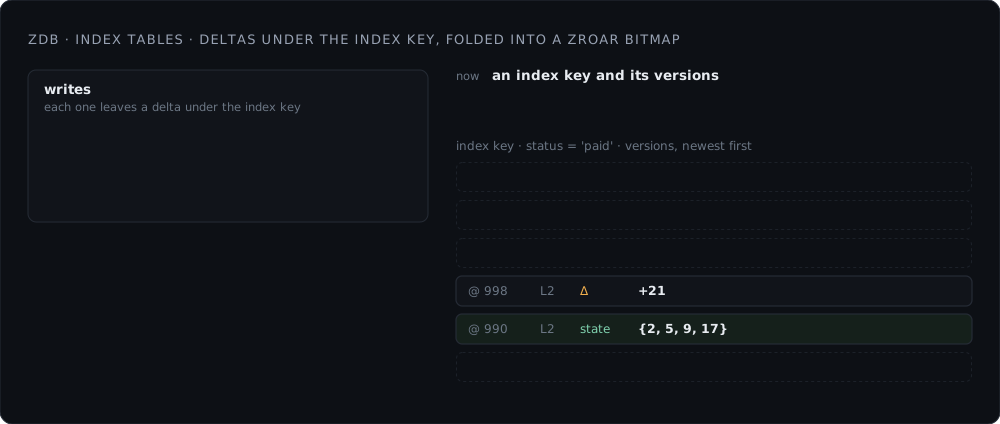
zdb understands that the values in an index table are 64-bit integers. A write that touches an index produces a delta under the index key: plus row ids, minus row ids. zdb stores these deltas as versions for the index key. As compactions run, zdb folds these deltas into roaring bitmaps using zroar, fetching the previous fold from lower levels if needed.
On index key lookup getBitmap(index_key, read_ts), zdb fetches only the
versions (<= read_ts) up until the first fold it finds, loads the bitmap,
applies the delta versions in order and returns a zroar bitmap valid as of the
read timestamp.
This native support for indexes results in efficient index operations. What
would be a bitmap index scan in Postgres (WHERE col1 = x) is a single index
key lookup returning pre-generated bitmaps in Egres. Where this shows up most is
a query across two indexes with no composite index: WHERE col1 = x AND col2 = y. Two seeks, one intersection resulting in row ids.
AND, OR and NOT across indexes become bitmap operations: the planner, admittedly simplistic as of this release, turns the index conditions into a tree of bitmap nodes. Each leaf is an index read yielding a zroar, AND nodes intersect and stop at the first empty set, OR nodes union, and the bitmap at the root picks the rows to fetch.
In the benchmarks, this is what makes the sku_day query 126x faster at p95: 490 ms in Postgres against 3.9 ms in Egres. On customer_day_count, the other two-index query, Postgres p95 took 15.1 ms against Egres 2 ms.
Batched Execution
Section titled “Batched Execution”Postgres pulls one row at a time through its tree of operators. Every row pays a function call per operator and the CPU never sees enough work at once to pipeline any of it. Egres does batched execution instead: the executor moves a batch of rows through the operators, so the operator overhead is paid once per batch rather than per row, and the rows an operator touches are already in cache. To avoid copies, each operator updates a bit set marking which rows are still selected.