No VACUUM. No Repack.
Status: available in the current release.
zdb stores updates to the same row as versions. Each version carries its 64-bit commit HLC timestamp, and a read at a timestamp returns the newest version at or below it. Every read is a fixed snapshot over the entire database.
zdb does one interesting thing here. Other LSM trees write (key, version ts)
composite as the key, with one entry per version. zdb encodes the versions in
the value itself, keeping only one key per row. This reduces the number of keys
in the system by a factor, results in smaller SSTable block indexes and faster
key lookups.
Garbage Collection
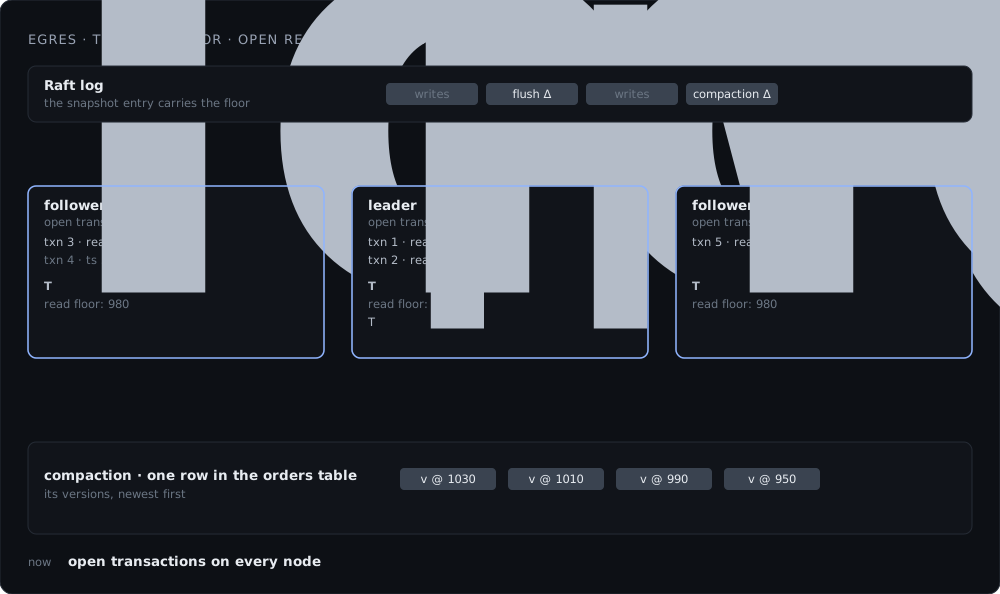
Section titled “Garbage Collection”Every Egres node tracks the minimum read timestamp of transactions currently running in the system, as Tlow. It is bound by a configurable maximum transaction age so an idle transaction cannot pin it forever. When followers reply to the leader’s heartbeats, they include their Tlow.
When creating and proposing a snapshot, the leader picks a Raft index in the
past, which is either past a certain age min_age_seconds, or leaves a certain
WAL size min_bytes, while ensuring it is picking all writes still in the
memtable. For that Raft entry, it finds its HLC timestamp = Tindex.
Then the leader calculates the minimum across all of these, with Tsnap = MIN(Tindex, Tlow for each node). When creating and proposing a snapshot, the leader sets this Tsnap. Once applied, every node in the cluster rejects reads below Tsnap. Note that because every replica’s open readers already counted towards the Tsnap, a replica doesn’t have to kill a running query to keep up (except one beyond its max age).
All compactions can then drop unneeded versions below Tsnap, hence garbage collecting them and freeing up space.
Simple, Effective GC
Section titled “Simple, Effective GC”Both Egres and Postgres keep old versions for as long as the slowest reader needs them. Egres does cap how long a transaction can stay open, so one forgotten session cannot pin versions forever. The difference is what happens afterwards.
In Postgres the dead tuples become holes in heap and index pages: VACUUM marks the space reusable, but the table stays at its high-water mark, with live rows spread thin across pages, until VACUUM FULL or pg_repack rewrites it. Moreover, Postgres has to vacuum even a table nobody writes to, to freeze its transaction ids before the 32-bit counter does.
In Egres, when Tsnap moves forward, the dead versions vanish at the next compaction of their files, and the live ones are rewritten into dense new files with no holes. Garbage collection piggybacks on compactions, which are much lighter than a VACUUM scan. Each compaction operates on a few files at a time, releasing disk space as it goes. Timestamps are 64-bit, so there’s no counter to wrap. Egres never has a reason to visit a cold tree, and cold trees skip compaction altogether.