Half the Disk, local or remote
Status: available in the current release.
ZDB: LSM Forest
Section titled “ZDB: LSM Forest”Egres runs on top of a new storage engine called zdb. While zdb bootstrapped as a port of Badger from Go to Zig, it quickly went way beyond Badger. zdb is a tree of LSM trees, aka an LSM forest, integrates heavily with Raft consensus and reuses the Raft write-ahead log instead of having its own.
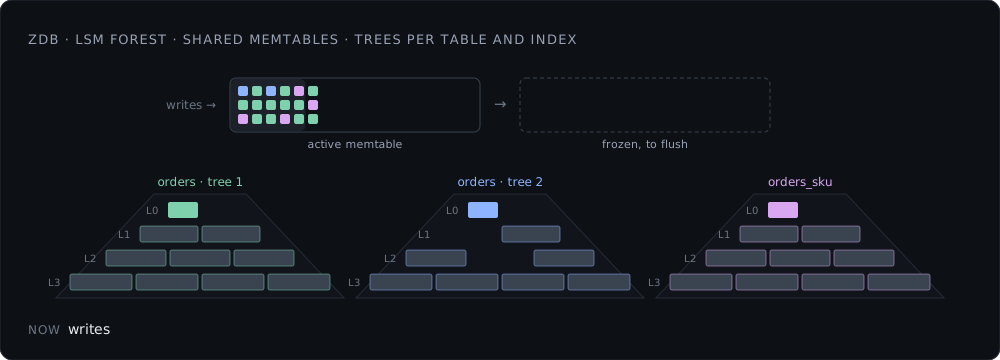
zdb mirrors the Postgres hierarchy. It has namespaces, which map to Postgres databases. Each namespace owns many zdb tables. Each SQL table, and each of its indexes, gets its own zdb table. Every zdb table is one or more LSM trees. The benefit of this hierarchy is that zdb can branch or drop a namespace, table or index instantly (see branching). Moreover, heavy writes to one table do not cause compaction pressure in another.
Shared Memtables
Section titled “Shared Memtables”An Egres instance which has hundreds of tables would have hundreds of LSM trees. A typical LSM tree would have in-memory tables, called memtables, and having memtables per tree would cause excessive memory usage.
To avoid that, zdb shares the same memtables across all namespaces, with keys
prefixed with (ns, table id). SSTables are owned by the tree; the (ns, table id) can be inferred, so SSTables don’t store that prefix. The SSTable iterator
sets the (ns, table id) prefix to the keys it outputs during iteration, thus
allowing accurate key comparisons across tables and namespaces.
Tree Splits
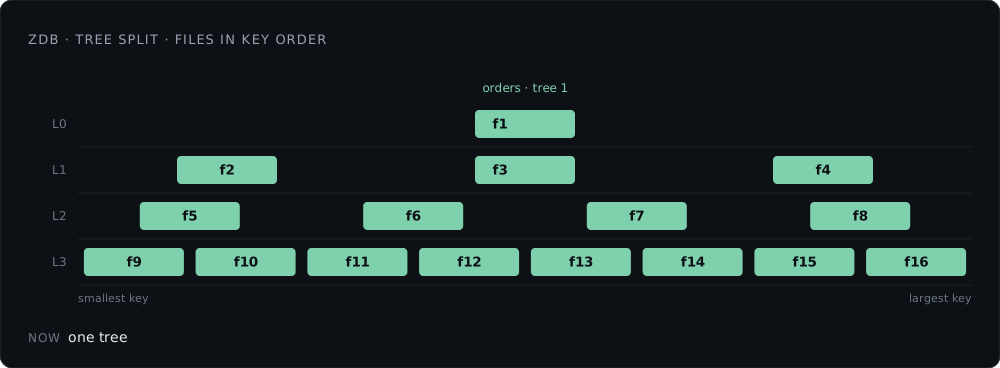
Section titled “Tree Splits”Each table starts with one LSM tree, but as tree size grows (> 10 GiB), zdb can split it in half to keep the compactions running predictably. Because each tree’s size is bounded, zdb only uses 4 levels (Level 0 to Level 3) per tree. Thus, each table can own many trees. Both the size and levels per tree are configurable.
Tree splits don’t cause any data movement. zdb finds a median key which would split the sizes as equally as possible based on the files in the last level, and assigns SSTable files to each side. The files which overlap are assigned to both. Later compactions only iterate over each tree’s assigned key range. Once split, trees can run compactions independently and concurrently. Moreover, a tree whose key range doesn’t get updates can avoid compactions entirely.
Compression and Checksum
Section titled “Compression and Checksum”zdb does block level compression, using the faster lz4 compression for L0 and L1 files, and the slightly slower but more powerful zstd for L2 and L3. On the benchmarks, Egres took about half the disk Postgres did, the same kind of saving that MyRocks brought to MySQL. Of course, savings from compression depend a lot on the kind of data being stored, so YMMV.
Every block carries a checksum, which is verified on every read, so a corrupt block is caught before it’s served. In the future, these blocks can also be encrypted to provide encryption at rest.
Local Disk Or Object Storage
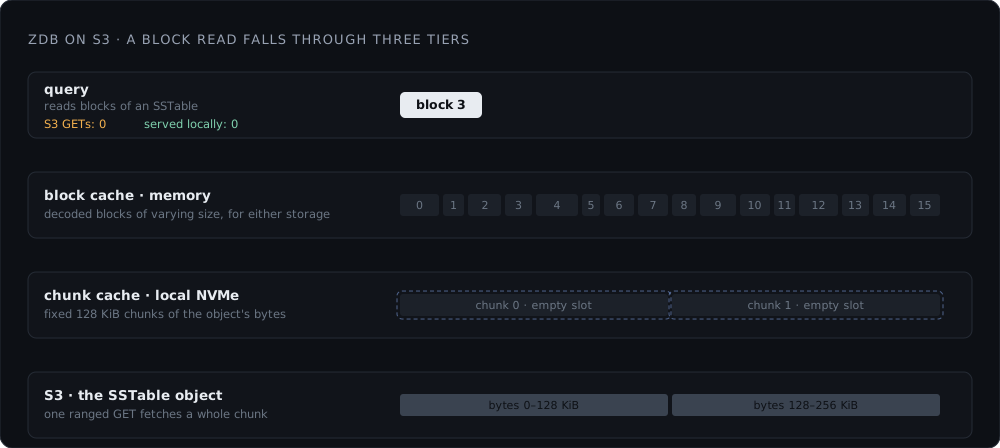
Section titled “Local Disk Or Object Storage”zdb runs on local disk, or on object storage using S3 APIs. This allows Egres to achieve a blazing fast NVMe experience with local storage. Or, a serverless experience with remote object storage providing compute storage separation. When using object storage, zdb uses a disk cache to store fixed-size file chunks on local disk (if available), reducing S3 API calls and the associated latency. This disk cache is in addition to the in-memory cache that zdb already uses to store SSTable blocks across both storage mediums.
In fact, zdb internally uses a simple interface for file access, which can be extended to other technologies like Azure Blob Store or Google Cloud Storage APIs, or HDFS, etc.
Remote Data, Local WAL
Section titled “Remote Data, Local WAL”Even when SSTables live on object storage, the WAL stays on local disk. A write is deemed committed when its WAL entry is durable, so WAL latency dictates commit latency. Only local disk delivers that at low latency; S3 does not. The WAL only needs a few gigabytes, which is cheap on local NVMe, so Egres keeps it there.
The cost is that an Egres node is not fully stateless: a replacement node gets the WAL from its Raft peers. That is fine here. One Egres node serves thousands of tenants and doesn’t need to scale to zero when some of them go idle, so there’s no need to move the WAL off the node to make compute disposable.