Transactions: Repeatable Read, Pessimistic Locking
Status: available in the current release.
Egres provides Snapshot Isolation, the same as Postgres’ repeatable read isolation. Serializable isolation is planned for future releases.
In Egres, write transactions run on the leader. At BEGIN, the transaction
assigns leader’s last applied timestamp as the read timestamp,
Tread. From then on, every read gets a fixed snapshot of the
database as of Tread. Reads do not block and do not acquire any locks,
unless FOR UPDATE.
Deadlock Detection
Section titled “Deadlock Detection”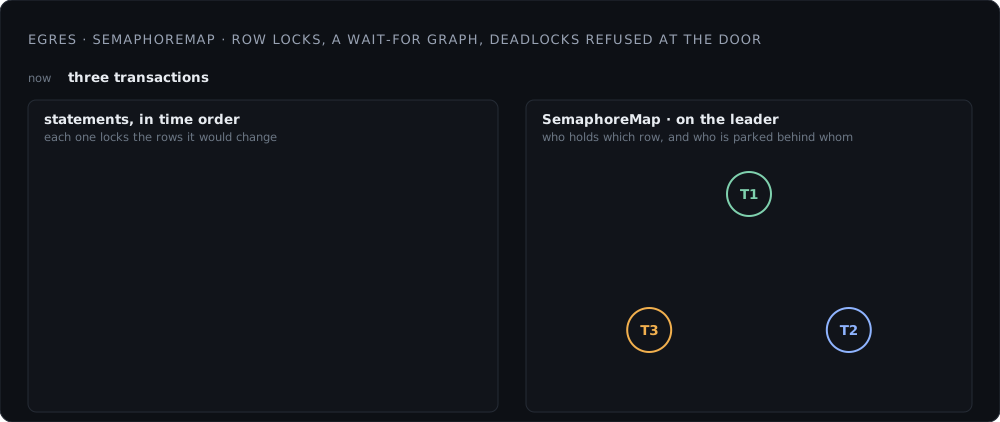
Writes use pessimistic locking. A write statement first gathers all the rows it would change, then locks them in key order to avoid cycles. Locking is done via SemaphoreMap which exists only in leader’s memory. In addition to holding locks, the map maintains a wait-for graph and detects any deadlocks at the time of lock acquisition. In case it finds a deadlock cycle, the transaction is immediately aborted and all held locks are released. There are no lock timeouts.
Conflict Detection
Section titled “Conflict Detection”The leader also keeps an in-memory Oracle: a map from row hash to its latest commit timestamp. After locks are acquired, their hashes are checked against the Oracle to find the max commit timestamp among them, Tmax_commit. If Tmax_commit is at or below Tread, nobody else changed them and the statement proceeds.
If Tmax_commit is higher than Tread, the rows are stale. Egres bumps up the Tread to Tmax_commit and re-runs the single statement; already acquired locks stay held.
A multi-statement transaction first checks if the earlier statements’ row hashes have Tmax_commit above Tread. If not, it executes the same way as above, updating Tread to Tmax_commit and re-running the current statement. Otherwise, it fails the transaction with 40001, the same serialization failure Postgres returns.
All of a transaction’s row and index writes go into a memtable owned by that transaction. When reading, this memtable is overlaid on zdb, so the transaction can see its own pending writes. Nothing touches storage or the Raft log until COMMIT, which proposes the entire write set, applied atomically on every replica. There is no validation phase at commit, because every conflict was settled by the locking described above before the statement wrote anything.
Pessimistic locking was chosen over optimistic on purpose. Dgraph had optimistic locking which caused abort storms under high contention. N transactions would race for a hot key, one wins, and N-1 waste all their work and have to re-do it. Pessimistic locking turns that contention into a queue, while disjoint transactions still run in parallel. Locks are taken on rows and unique index keys only. Non-unique index updates to the same index key run concurrently.